Preserving Your Child’s Vision
Myopia, the medical term for nearsightedness, occurs when your eyes focus near objects clearly, but distant objects appear blurry. Myopia is common, affecting 42% of children between 5 and 19.
In children, myopia often results from the eye being too long. Children’s eyes are still growing, and in those with myopia, their eyes tend to grow longer than they should. This means your child may need stronger glasses every year, as their eye continues to grow. In addition to the increasing blurred vision, myopia can cause an increase in more serious eye conditions like glaucoma and retinal diseases.
Myopia management is a process that aims to slow the growth, preserving visual clarity and preventing more serious eye diseases. It’s most effective when started early, so it’s important to schedule annual eye exams for your child to monitor their eyes.
Book Online
Why Is Myopia Management Necessary?
Myopia management is not only about preserving your child’s vision to avoid a higher prescription in adulthood. Myopia also increases the risk of developing serious sight-threatening conditions, such as retinal detachment, myopic macular degeneration, glaucoma, and cataracts. The higher their level of myopia, the higher the risk.
By slowing myopia progression through myopia management methods, we can reduce their risk of developing these serious eye conditions. This helps preserve your child’s vision, eye health, and overall quality of life for the future.
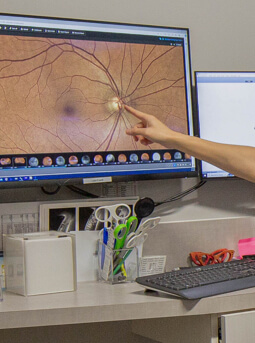
How We Monitor and Detect Myopia
Myopia is more than a prescription—it is a condition driven by eye growth. While glasses and contact lens prescriptions (refraction) tell us how clearly your child sees today, they do not fully capture how the eye is changing over time.
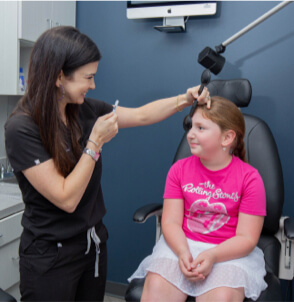
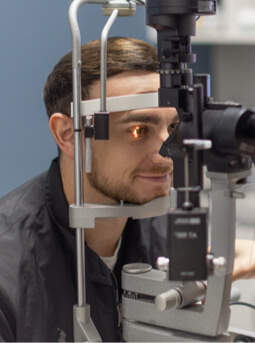
At Bellaire Family Eye Care, we monitor myopia using both refraction and axial length measurements, with particular emphasis on axial length. Axial length measures the eye from front to back and provides a direct, objective assessment of eye growth. This measurement allows us to track myopia progression with greater precision than prescription changes alone.
In children with myopia, axial length is typically longer than in children without nearsightedness. Importantly, axial length can increase before meaningful changes appear in a child’s prescription, meaning some children show early signs of myopia progression even while their vision still appears “stable.” By identifying these changes sooner, we can intervene earlier—when treatment is often most effective.
Many offices rely solely on prescription changes to assess myopia. By incorporating axial length measurements into our care, we are able to better assess risk, monitor progression more accurately, and tailor treatment decisions to each child’s long-term eye health—not just what they see on the eye chart today.
Our Myopia Management Methods
Traditional glasses and contact lenses can help your child see clearly, but they don’t slow the progression of nearsightedness. That’s because they correct vision straight ahead, while the side (peripheral) images are focused slightly behind the eye.
When images are focused behind the eye, the eye may respond by continuing to grow longer. As the eye grows, nearsightedness increases.
Myopia management lenses are designed differently. They keep central vision clear and intentionally change how light focuses in the side vision. By bringing peripheral images slightly in front of the eye instead, these lenses send a signal that the eye does not need to keep growing—helping slow myopia progression over time.
There are several treatment options available. Your child’s treatment plan will vary depending on their age, preferences, and lifestyle needs (such as extracurricular activities). We will monitor the efficacy of the treatment through the process to inform our plan.
Soft multifocal and bifocal contact lenses were originally designed for adults over age 40 to help with presbyopia (age-related difficulty focusing up close). However, research has shown that these same lens designs can be highly effective for slowing myopia progression in children.
When used for myopia management, these lenses work by guiding light in a way that helps reduce the signals that drive excessive eye growth. Studies suggest that soft multifocal contact lenses can slow myopia progression by approximately 50%.
While this use is considered off label, it is well supported by clinical research and widely used by eye care professionals who specialize in myopia management.
Essilor Stellest lenses are FDA-approved eyeglass lenses designed to slow myopia progression—not just correct vision. Unlike traditional glasses, Stellest lenses manage how light focuses in both central and side vision to help reduce signals that drive excessive eye growth.
Clinical studies show Stellest lenses can reduce myopia progression and eye growth by approximately 60–67% compared to regular single-vision glasses. They are worn just like everyday glasses and offer a non-invasive option for children who are not ready for contact lenses or as part of a customized myopia management plan.
Soft multifocal and bifocal contact lenses are typically used in adults over 40 with presbyopia (age-related farsightedness).
Multifocal contact lenses bend light in a way that is beneficial to the eye. Research suggests that multifocal contact lenses can slow myopia progression by approximately 50–87.5%.
Orthokeratology lenses, or ortho-k, are worn overnight and gently reshape the cornea (the clear front part of the eye) while you sleep. During the day, you can see clearly without glasses or contact lenses.
In children, studies on ortho-k lenses have shown, on average, a 50% reduction in myopia progression compared to standard single vision contact lenses or glasses. They make a great option for active kids and allow you to be home to supervise your child during the treatment, as they only wear the lenses at night.
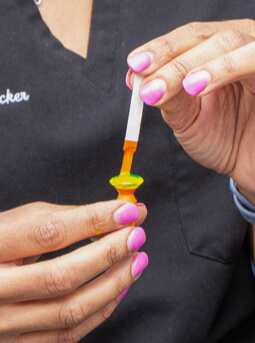
Atropine eye drops have long been used in eye care to dilate the pupils. When used in very low doses, atropine has been shown to help slow the progression of myopia without the unwanted side effects seen at higher strengths, such as blurred near vision or increased light sensitivity.
Low-dose atropine is typically used in concentrations from 0.01% to 0.05% and is applied once nightly at bedtime. For some children, atropine may be used on its own, while for others it can be safely combined with additional myopia management treatments to enhance overall effectiveness.
Protect Your Child’s Eyes for the Future
Your child’s eyesight plays an important role in how they learn, grow, and experience the world. Through regular eye exams, we can gently monitor your child’s vision and eye development over time and identify early signs of myopia, helping reduce the risk of future complications associated with higher levels of nearsightedness.
Healthy daily habits can also make a meaningful difference. Encouraging time outdoors and taking breaks from screens may help support your child’s visual development. Research shows that limited exposure to natural daylight and increased close‑up activities—such as reading, writing, and using digital devices—can increase the likelihood of developing myopia. While outdoor time cannot stop myopia from progressing, it may help delay when it begins.
Taking a proactive approach with regular eye exams allows us to care for your child’s eyes as they grow. If your child has already been diagnosed with myopia, we’re here to help. We invite you to schedule an appointment to learn more about our myopia management options and how we can work together to support your child’s long‑term eye health.
Book Online
Visit Our Location
Where to Park
We’re located at 5001 Bissonnet Street, between South Rice and North 3rd Avenues.
Free parking is available in the lot below the building.
Our Address
- 5001 Bissonnet St #107
- Bellaire, TX 77401
Contact Information
- Phone: 713-664-8087
- Email: appointments@bfeye.com
Hours of Operation


What Our Patients Are Saying
Lorem ipsum Lorem ipsum Lorem ipsum Lorem ipsum Lorem ipsum Lorem ipsum Lorem ipsum Lorem ipsum Lorem ipsum Lorem ipsum Lorem ipsum Lorem ipsum Lorem ipsum Lorem ipsum Lorem ipsum Lorem ipsum

John Doe
Lorem ipsum Lorem ipsum Lorem ipsum Lorem ipsum Lorem ipsum Lorem ipsum Lorem ipsum Lorem ipsum Lorem ipsum Lorem ipsum Lorem ipsum Lorem ipsum Lorem ipsum Lorem ipsum Lorem ipsum Lorem ipsum
John Doe